
Introduction
Homeowners across Fairfield County ask this question every spring as temperatures warm and the first mosquitoes start appearing around patios, pools, and play areas. This article explains how mosquito treatments work in Connecticut yards, what homeowners can realistically expect, and why an integrated approach is recommended for effective control. The intended audience is Connecticut homeowners who want to understand the effectiveness of mosquito treatments and make informed decisions about protecting their outdoor spaces. Understanding how mosquito control works is important because it helps set realistic expectations, ensures the safety of family and pets, and supports environmentally responsible pest management.
The honest answer to whether mosquito treatments work is nuanced—and worth understanding before you invest in any mosquito control program. In certain circumstances, such as periods of high disease risk or when other control measures have failed, chemical interventions may be necessary for effective mosquito control.
Key Takeaways
Professional mosquito treatments do work to significantly reduce mosquito activity on Fairfield County properties, though they cannot completely eliminate mosquitoes from any outdoor space.
The most effective way to control mosquitoes is through an integrated approach that combines professional mosquito spraying with habitat management, such as removing standing water, larval control using BTI dunks, vegetation maintenance, and ongoing property monitoring.
Professional mosquito control targets adult mosquitoes where they rest during the day—in shrubs, shaded vegetation, wooded edges, and under decks—while also addressing breeding sites around the property.
With consistent treatments through the season, most homeowners experience dramatically fewer mosquito bites and can enjoy outdoor spaces more comfortably, though occasional mosquitoes are still normal.
Guidance in this article aligns with recommendations from the CDC, EPA, Connecticut Department of Public Health, and the Connecticut Agricultural Experiment Station.
Do Mosquito Treatments Actually Work? (Short Answer for CT Homeowners)
For homeowners in Greenwich, Darien, New Canaan, Stamford, Westport, Weston, Wilton, Ridgefield, Norwalk, and Fairfield, the straightforward answer is yes—mosquito treatments work to reduce mosquito activity, but they will not provide 100% elimination.
Professional mosquito sprays, when applied every three to four weeks from late spring through September, routinely cut mosquito activity by a substantial margin around decks, patios, pools, and play areas. Research shows that barrier treatments combined with larval habitat management can achieve significant suppression lasting at least 25 days in suburban environments. These treatments work by targeting adult mosquitoes resting in vegetation and by interrupting parts of the breeding cycle, though mosquitoes can still migrate in from neighboring properties or wetlands. Proper application is essential for optimal results, ensuring the spray reaches the right areas and concentrations for effective mosquito control.
The difference between professional property-wide treatments and DIY solutions is significant. Bug zappers, citronella candles, and consumer-grade sprays offer limited protection—often killing more beneficial insects than mosquitoes or providing only temporary relief in a small radius compared with professional, family-safe tick and mosquito prevention services across Fairfield County. There is limited scientific data supporting the effectiveness of some consumer devices, such as fans, in repelling mosquitoes. Professional methods are more systematic, use commercial-grade equipment to reach deep into landscaping, and function as part of a broader mosquito control plan.
Set your expectations accordingly: treatments are about control and reduction rather than creating a mosquito-free bubble, especially in wooded, humid Connecticut environments where roughly 54 mosquito species exist—about half of which are considered nuisance species or potential disease vectors. Integrated approaches aim to control mosquito populations through surveillance, habitat elimination, and targeted interventions.
How Mosquitoes Behave on Connecticut Properties
Understanding local mosquito behavior helps explain why certain treatments work and why some areas need more attention than others. According to the Connecticut Agricultural Experiment Station, common species in southern Connecticut include Culex pipiens (the common house mosquito), various Aedes and Ochlerotatus species, and saltmarsh mosquitoes in coastal communities.
Mosquitoes undergo four life stages: egg, larva, pupa, and adult, with the entire lifecycle typically taking 7 to 10 days under optimal warm conditions. Mosquitoes can breed in as little as a tablespoon of standing water, making it crucial to eliminate potential breeding sites to control their populations. Female mosquitoes require a blood meal to develop and lay eggs, which they typically deposit in standing water. Some natural predators, such as certain fish and insects, eat mosquito larvae, which can help control mosquito populations. Adult mosquitoes can live for several weeks to months depending on environmental conditions, with overwintering females capable of surviving up to eight months in sheltered locations like leaf litter or building interiors.
During the day, adult mosquitoes rest in cool, humid, shaded areas. Common resting sites on Fairfield County properties include:
Dense shrubs and ornamental plantings
Under decks and porches
Along wooded edges and fence lines
Groundcovers like pachysandra
Stone walls and shaded structures
Peak activity for many species occurs around dawn and dusk—exactly when homeowners want to use patios, playsets, and lawns.
Common Breeding Sites in Connecticut
Mosquitoes can breed in as little as a tablespoon of standing water, making it crucial to understand where larvae develop on residential properties. Typical breeding locations include:
Clogged gutters (holds water for weeks)
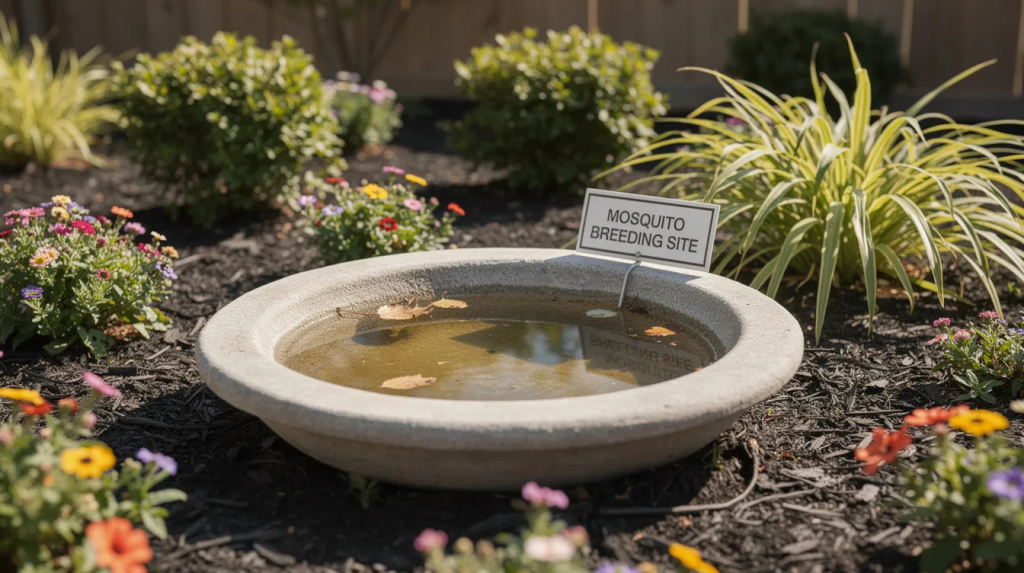
Bird baths (stagnant water refreshed infrequently)
Pool covers (collects rainwater in low spots)
Plant saucers (often overlooked)
Children’s toys (holds water after rain)
Low lawn areas (creates temporary pools)
Tree holes (natural water collection points)
Old tires (classic mosquito breeding habitat)
Flat roofs (can collect standing water if not properly drained)
Wooded and shaded landscapes common in Greenwich, New Canaan, Westport, and Ridgefield naturally provide ideal resting habitat, which explains why those properties often need more diligent mosquito control. Even a small amount of stagnant water in a forgotten wheelbarrow or tarp can produce dozens of mosquitoes within two weeks.
Types of Mosquito Treatments and What They Actually Do
The term “mosquito treatment” covers several different tools, each playing a distinct role in controlling mosquitoes. Understanding these options helps homeowners make informed decisions about what their property actually needs.
For a Connecticut home, the most relevant categories are:
Professional barrier spraying on vegetation
Larval control in standing water (BTI dunks or bits)
Integrated mosquito traps (such as In2Care systems)
EPA-registered mosquito repellent for personal use
Some methods target adult mosquitoes while others target the larval stage in water. An effective plan generally uses multiple approaches. Bug zappers and many consumer “mosquito traps” often disappoint for yard-wide mosquito control because they kill many other insects or fail to outcompete human attractants in the outdoor space.
Professional Mosquito Sprays (Barrier Treatments)
Barrier treatments involve applying professional mosquito sprays with high-pressure skid sprayers to shrubs, hedges, lower tree canopies, ornamental beds, under decks, fence lines, and wooded borders where adult mosquitoes rest.
Products commonly used in professional mosquito control are synthetic pyrethroids or similar EPA-registered formulations. The active ingredient bonds to foliage and provides residual control for approximately 21 to 30 days, depending on weather and product type. Professional-grade mosquito sprays tend to last longer than consumer-grade options, with some formulations providing protection for up to a month before effectiveness begins to degrade.
Safe Tick Control uses commercial-grade equipment to reach deep into landscaping, stone walls, and shaded beds, providing more thorough coverage than simple perimeter-only or backpack applications. These sprays do not kill mosquitoes mid-flight—instead, mosquitoes resting on treated leaves and surfaces receive a lethal or repellent dose when they land.
Barrier treatments are most effective when applied properly and timed regularly through the warm season, typically late spring to early fall in Fairfield County. Heavy rain, direct sun exposure, and foliage growth can reduce the residual duration of treatments.
Larval Control: Treating Mosquitoes at the Source
Larval control targets the larval stage in standing water before mosquitoes emerge as biting adults. This approach aligns with CDC and EPA integrated pest management guidance, which emphasizes disrupting the mosquito reproduction cycle where it begins.
Mosquitoes lay eggs in standing water, so eliminating sources around the home is crucial for effective mosquito control. When water sources cannot be removed, BTI (Bacillus thuringiensis israelensis) in the form of mosquito dunks or bits provides an effective solution. Using EPA-registered larvicides can effectively target mosquito larvae in breeding habitat before they mature into adults.
BTI is highly specific to mosquito larvae and black flies with minimal impact on other wildlife—making it safe for use in bird baths, ornamental ponds without fish, rain barrels, and other semi-permanent water features. Homeowners in Greenwich, Norwalk, Stamford, and other towns should inspect properties weekly for water-holding items and either dump the water or treat appropriately.
Safe Tick Control technicians can identify chronic breeding areas during service visits and advise whether larval treatments or drainage improvements make sense for your property as part of their professional tick and mosquito control services in Greenwich, CT. Larval control is highly efficient because it prevents large mosquito populations from ever becoming adults, reducing the biting pressure on your property.
Mosquito Traps, Bug Zappers, and Other Gadgets
Modern integrated mosquito traps, such as In2Care systems, use attractants plus larvicides to target mosquitoes at both adult and larval stages. These can be useful supplements in properties with particular mosquito issues, especially near wetland edges.
Bug zappers and traditional light-based traps tell a different story. These devices kill many night-flying insects but relatively few mosquitoes. Studies consistently show that bug zappers attract and destroy moths, beetles, and other beneficial insects more effectively than they reduce mosquito populations. They are not recommended as a primary mosquito control strategy for Fairfield County homeowners.
Similarly, ultrasonic devices marketed for mosquito control have shown no proven effectiveness in scientific testing. Many consumer CO₂-based traps can catch mosquitoes but may not reduce biting enough across a large, wooded Connecticut yard unless carefully placed and used alongside other tactics.
View traps and gadgets as supporting tools rather than replacements for habitat reduction and well-planned treatments.
Personal Mosquito Repellents and Other On-Person Protection
The CDC and Environmental Protection Agency recommend certain active ingredients in mosquito repellent for skin and clothing protection. Products containing DEET, picaridin, IR3535, or oil of lemon eucalyptus provide effective personal protection when used according to label directions. Mosquito sprays can vary in effectiveness depending on active ingredients and concentrations, with products containing DEET being recommended by the CDC for their ability to repel mosquitoes effectively.
Personal protection measures also include wearing long pants and long-sleeved shirts to reduce exposed skin, and using permethrin-treated clothing for added defense, especially in wooded areas or during peak mosquito activity hours. Repellents containing DEET or Picaridin, as well as permethrin-treated clothing, are highly recommended for comprehensive protection against mosquito bites.
Personal repellents protect people, not the yard itself. They work best alongside property-wide mosquito control treatments. Even on a professionally treated property, keeping a preferred repellent available for high-activity times or evening gatherings makes sense.
Essential oils, while popular as natural options, have been found less effective than synthetic options like DEET. Many essential oil products show minimal effectiveness after about an hour, requiring frequent reapplication.

Integrated Mosquito Control Management: Why a Combined Approach Works Best
Integrated pest management (IPM) is a comprehensive approach that combines prevention, habitat management, and targeted interventions to control pests while minimizing environmental impact. The CDC, EPA, and state health agencies endorse this strategy because it addresses mosquito biology at every life stage rather than relying on a single tactic.
The use of integrated pest management strategies is encouraged to minimize environmental impact, focusing on prevention and habitat management rather than solely relying on chemical treatments. Effective mosquito control requires a comprehensive approach that includes removing mosquito habitats, using structural barriers, controlling mosquitoes at the larval stage, and applying adulticides when necessary.
For a Fairfield County home, an integrated approach typically includes:
Professional barrier spraying every 3-4 weeks
Larval control in water features and containers
Source reduction (eliminating standing water)
Vegetation management to reduce resting habitat
Ongoing property monitoring throughout the season
Safe Tick Control follows this integrated philosophy, focusing not just on spraying but also on identifying habitat issues and tailoring recommendations to each property’s layout, shade patterns, and moisture levels.
Eliminating and Managing Standing Water
Source reduction—removing standing water—is considered the most effective long-term solution for mosquito control. Since mosquitoes can breed in minimal water, systematic elimination of breeding sites dramatically reduces the number of adults that emerge on your property.
Walk your property weekly and check for any item or low spot holding water for more than a few days. Common problem areas include:
Clogged gutters along older Fairfield and Stamford homes
Sagging or ill-fitting pool covers
Bird baths left unchanged for weeks
Children’s toys, grill covers, and wheelbarrows
Plant saucers and rain gutters
Wading pools and tarps
Low spots where water pools after rain
For unavoidable water features like decorative ponds, large rain barrels, or drainage swales, BTI-based larvicides or properly designed circulation systems control mosquito larvae effectively. Homeowners can use mosquito dunks for homeowner use in most standing water situations on their property.
Systematic water management makes every spray treatment more effective by reducing the number of new adults constantly emerging.
Vegetation and Landscape Management
Dense, unmown, or overgrown vegetation creates cool, humid resting habitat for adult mosquitoes. This is especially problematic along shaded tree lines, around stone walls, and in thick foundation plantings where mosquitoes wait out the heat of the day.
Practical vegetation management includes:
Trimming back shrubs from patios and gathering areas
Thinning overly dense groundcovers
Keeping grass reasonably short in high-use zones
Clearing brushy undergrowth along property edges
Pruning lower branches to increase airflow
In heavily wooded Fairfield County neighborhoods like Weston, Wilton, and Ridgefield, homeowners may not want to remove mature trees. However, selective pruning and clearing of brushy undergrowth can meaningfully reduce mosquito resting sites without dramatically changing the landscape character.
Safe Tick Control technicians can point out areas of heavy vegetation where mosquitoes concentrate and adjust spray patterns to target those zones more thoroughly. Thoughtful landscape management also supports better tick control—a natural complement to the company’s tick and mosquito control services in Greenwich, Connecticut.
Consistent Seasonal Scheduling and Property Monitoring
Mosquito control is not a one-time event. Most mosquito control companies recommend treatments every three to four weeks to maintain effectiveness against mosquito populations. In Connecticut, this typically means regular service from late spring through early fall.
The timing of mosquito activity peaks in Connecticut from early August to early October, necessitating consistent seasonal treatment through these high-pressure months. Skipping treatments mid-season allows populations to rebound quickly, especially after heavy rains create new breeding opportunities.
Local treatments require routine reapplication to maintain a protective shield due to the mobility of mosquitoes that can travel from neighboring properties. New adults are constantly emerging from local and nearby breeding sites, which is why consistency matters more than any single treatment.
During each visit, Safe Tick Control technicians reassess property conditions, adjust treatment patterns, and identify new standing water or vegetation issues. Contact your provider if you notice unusual spikes in mosquito activity between visits—heavy rain events or nearby construction can suddenly alter conditions.
How Professional Mosquito Spraying Works on a Fairfield County Property
Understanding what happens during a professional treatment helps set realistic expectations. A typical mosquito treatment visit from Safe Tick Control begins with a targeted inspection of wooded edges, plantings, under decks, and around potential breeding sites.
Technicians use professional high-pressure skid sprayers to deliver fine droplets that coat the underside of leaves, dense shrubs, ornamental beds, stone walls, and other shaded resting spots. This approach reaches areas that backpack sprayers or perimeter-only treatments miss entirely.
Typical dry time ranges from a few hours depending on humidity and product, during which children and pets should stay off treated areas as directed by product labels and EPA guidance. Homeowners usually notice a reduction in visible mosquito activity within the first day or two, with protection lasting around three to four weeks before reapplication is recommended.
Targeting Adult Mosquito Resting Sites
Professional treatments prioritize specific resting sites where adult mosquitoes spend daytime hours:
Undersides of leaves in shrubs and ornamental plantings
Lower branches of trees along property edges
Shaded areas behind sheds and outbuildings
Under decks and porches
Near stone walls and retaining walls
Along forested property borders
Because mosquitoes are weak flyers that prefer sheltered locations, treating these resting areas intercepts them before they become active at dusk. Safe Tick Control’s full-property approach is especially useful on large lots with extensive landscaping in Greenwich, New Canaan, and Westport.
Grass areas are treated only when appropriate, focusing mainly on shady edges rather than open sun-baked turf where mosquitoes rarely rest.
How Weather and Property Layout Affect Results
Weather significantly influences both mosquito populations and treatment longevity. Heavy rain can wash treatments from foliage and create new breeding sites simultaneously. Extended dry spells may reduce mosquito activity but concentrate remaining populations around any available water.
Properties bordering wetlands, ponds, or tidal marshes—common in coastal towns like Greenwich and Norwalk—experience higher background mosquito pressure. These homeowners benefit most from integrated tactics and consistent treatment schedules throughout the entire area where family members spend time outdoors.
Wind exposure helps reduce mosquito landings on some open, hilltop yards, while deeply shaded, sheltered backyards tend to hold more mosquitoes and require thorough spraying. Mention any known wet areas, basement drains to yard outlets, or backyard streams so technicians can factor those into treatment plans.
Safety and Environmental Considerations
Safe Tick Control follows product labels and best practices aligned with EPA and Connecticut Department of Energy and Environmental Protection guidance. Professional mosquito sprays are EPA-registered and, when applied properly and allowed to dry, are considered low-risk for typical residential use.
However, no pesticide application is completely risk-free. Mosquito control pesticides can be toxic to non-target insects, including beneficial pollinators like honey bees and other pollinators, if not used properly. Treatments are timed and targeted to limit drift and avoid direct spraying of flowering plants whenever possible, focusing instead on non-flowering vegetation where mosquitoes rest.
Many commonly used mosquito sprays contain pyrethroids, which are highly toxic to aquatic invertebrates and can pose risks to the environment if they enter water systems. Regulatory agencies set guidelines to prevent this, and responsible applicators follow setback requirements near water bodies.
Children and pets should remain off treated areas until sprays have fully dried, with clear post-treatment instructions provided at each visit. Some homeowners prefer lower-impact options—organic cedar oil treatments for ticks and carefully selected products can fit into an integrated plan, though these require more frequent applications. Natural treatments using concentrated essential oils act as strong spatial repellents but require reapplication typically every 14 days.
What Connecticut Homeowners Can Realistically Expect from Mosquito Treatments and Mosquito Bites
Set your expectations based on what professional mosquito control actually delivers: substantial reduction in mosquito bites and nuisance around key outdoor spaces, but not complete absence of mosquitoes. Research indicates that well-executed programs can reduce mosquito populations by 60 to 90 percent in treated areas, though results vary based on property conditions and weather.
In many Fairfield County yards on consistent programs, homeowners report being able to use patios, pools, and play areas most evenings with minimal need for personal repellent. You can keep mosquitoes at bay for comfortable outdoor gatherings, though occasional mosquitoes remain possible—especially after heavy rains or in high-pressure weeks.
Professional mosquito control services typically cost between $40 and $70 per treatment, with total costs ranging from $500 to $900 for a three-month season depending on property size and treatment frequency. The cost can vary significantly based on specific services provided, with some companies offering seasonal preventative programs.
Results are best when homeowners partner in the process by managing standing water, trimming vegetation, and communicating about unusual mosquito surges. View mosquito control as an ongoing seasonal service—similar to lawn care or pool maintenance—rather than a one-time fix.
Safe Tick Control’s Approach to Mosquito and Tick Management
Safe Tick Control is a locally operated tick and mosquito control company serving towns across Fairfield County, including Fairfield tick and mosquito control services, Greenwich, Darien, New Canaan, Stamford, Westport, Weston, Wilton, Ridgefield, Norwalk, and Fairfield.
The company focuses on full-property treatment rather than narrow perimeter bands, using commercial-grade equipment to reach wooded edges, stone walls, shaded beds, and other pest hot spots. This approach addresses both ticks and mosquitoes comprehensively for Fairfield County communities such as New Canaan tick and mosquito control clients.
Services include:
Synthetic mosquito and tick treatments
Organic cedar oil tick treatment options
Tick tubes for targeted rodent-host control
Seasonal programs designed around peak Connecticut pest activity, including dedicated Norwalk-area tick control and prevention services
Safe Tick Control emphasizes child- and pet-conscious applications, clear communication, and property-specific recommendations for larval control, standing water management, and vegetation adjustments. Homeowners considering mosquito treatment can schedule a consultation where technicians walk the property, explain realistic expectations, and recommend an integrated, season-long plan, including tick and mosquito control services in Stamford, Connecticut.

FAQ: Common Questions About Mosquito Treatments in Fairfield County
Can mosquito treatments also help with ticks on my property?
While mosquito sprays may incidentally affect some ticks in treated vegetation, ticks live and quest primarily in leaf litter, shaded groundcover, stone walls, and woodland edges. This means they require targeted tick control strategies beyond what mosquito treatments provide.
Safe Tick Control offers dedicated tick treatments and tick tubes designed specifically for local tick species and Lyme disease risk, including their professional tick prevention services for Greenwich-area properties. Disease control for both pests is most effective with separate, targeted programs. Homeowners concerned about both should choose an integrated tick and mosquito program rather than relying on mosquito-only treatments.
How soon after a mosquito treatment can my children and pets go back outside?
In general, children and pets should remain off treated areas until the product has completely dried, which typically takes a few hours depending on humidity and sunlight. Technicians provide specific guidance after each treatment based on products used and current weather conditions.
Once dry, EPA-registered products used according to label directions are designed to be low-risk for typical residential exposure. Following post-treatment instructions is important for safety.
Will one mosquito treatment be enough for the whole summer?
A single treatment provides several weeks of noticeable improvement but will not protect your property for an entire Connecticut mosquito season, which runs from late spring into early fall. New adult mosquitoes constantly emerge after rains and warm spells.
Regular treatments—typically every three to four weeks—maintain control throughout the season. One-time services can work for specific outdoor events, but homeowners wanting season-long comfort should consider recurring programs.
Are natural or organic mosquito treatments as effective as synthetic options?
Some natural or essential oil-based formulations provide shorter or more variable control compared with conventional synthetic products, especially under heavy mosquito pressure. Essential oils generally require more frequent reapplication—typically every 14 days—and may offer more modest reduction than synthetic programs.
Safe Tick Control offers organic cedar oil treatments for ticks and carefully selected options for integrated programs, including organic tick spray and prevention services in Greenwich and nearby towns. Homeowners who prioritize lower-impact options should discuss goals and trade-offs so a realistic, customized plan can be created. Physical control methods and habitat reduction become even more important when choosing natural approaches.
What if my neighbor doesn’t treat their yard—will my mosquito treatments still work?
Treatments remain beneficial even when surrounding properties are untreated because they target mosquitoes resting and emerging on your property’s vegetation and breeding sites. Your yard becomes significantly less hospitable to mosquitoes even if they exist elsewhere.
Some mosquitoes will migrate from neighboring yards or nearby wetlands—this is why complete elimination isn’t realistic. However, a well-treated property typically experiences far fewer bites than untreated surroundings. Some neighbors in the same neighborhood coordinate services, which can further improve control across property lines and prevent mosquitoes from simply moving between adjacent yards, especially in communities using shared Westport tick and mosquito control programs.