
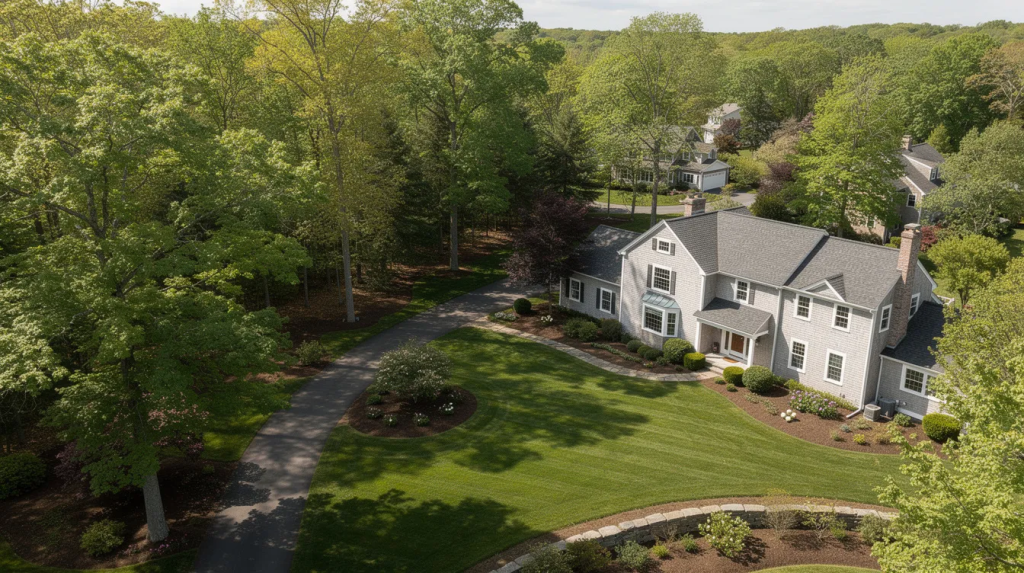
If you own a larger residential property in Fairfield County-whether it’s a wooded two-acre lot in Weston or a landscaped estate in Greenwich-you’re likely familiar with the challenge mosquitoes present during Connecticut’s warmer months. The same features that make these properties desirable-mature trees, privacy hedges, stone walls, naturalized borders-also create ideal conditions for mosquito populations to thrive. Here’s what actually works for mosquito control on properties where a quick perimeter spray simply isn’t enough.
Fast answer: how to control mosquitoes on larger Connecticut properties
Large, wooded properties throughout Fairfield County naturally harbor more mosquitoes than smaller, open suburban lots. Towns like Greenwich, Darien, New Canaan, Westport, Weston, Wilton, Ridgefield, and Fairfield are home to countless estates and multi-acre properties with extensive tree cover, ornamental landscaping, wetland edges, and shaded outdoor living spaces. These landscape features provide exactly what mosquitoes need: humid resting areas, sheltered vegetation, and standing water for breeding.
Effective mosquito control on these properties combines full-property professional spraying, standing water management, and consistent homeowner prevention habits. Effective mosquito treatments for large properties often benefit from a community wide effort, where residents, local agencies, and organizations work together to eliminate breeding sites and reduce mosquito populations across neighborhoods. This isn’t about achieving total elimination—the CDC and Connecticut Agricultural Experiment Station (CAES) are clear that complete mosquito eradication is unrealistic given surrounding habitats and weather factors. The realistic goal is meaningful mosquito reduction that allows families to actually use their outdoor spaces during spring and summer.
Professional treatments focus on the areas where mosquitoes actually rest and breed—shaded vegetation, wooded edges, damp spots, and dense landscaping—rather than just open lawn space. In addition to local specialists like Safe Tick Control, reputable pest control providers such as Terminix and others offer mosquito management solutions for large residential properties. A typical seasonal program from Safe Tick Control includes:
Treatments scheduled every 3-4 weeks (synthetic) or 2-3 weeks (organic cedar oil) from late April through September
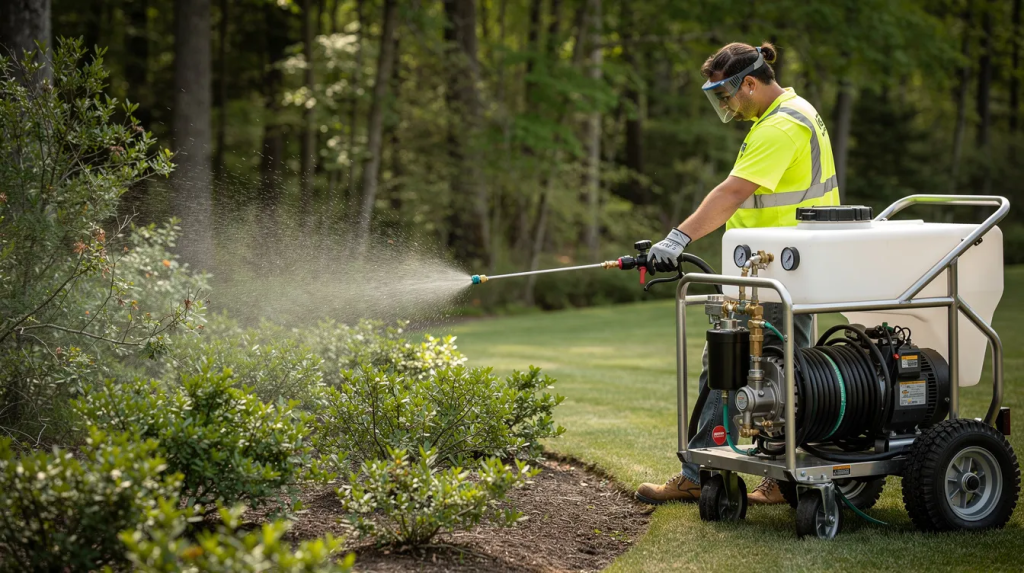
High-pressure skid sprayer applications covering full property perimeters, wooded borders, and landscape beds
Backpack misting for detailed work around decks, patios, stone walls, and dense plantings
Attention to mosquito larvae sites and standing water during each visit
Awareness of public health context, including West Nile virus activity monitored throughout Fairfield County each season
How mosquitoes behave on large Connecticut residential properties
On estates and wooded lots, mosquito populations are often driven more by nearby wetlands, vernal pools, and poorly drained areas than by the lawn itself. Common mosquito breeding sites include tree holes, clogged gutters, discarded containers, and any stagnant water sources around homes. Small containers like clogged gutters, toys, buckets, and tarps can produce just as many mosquitoes as larger water features like pond edges or drainage ditches—both matter on larger properties where these features multiply. Scientific data supports the importance of eliminating standing water in items such as bird baths, plant pots, and old tires, as these can become ideal habitats for mosquito larvae and are proven breeding sites that should be addressed as part of effective mosquito treatments for large properties.
Key mosquito breeding and resting zones on big Fairfield County lots
Identifying and mapping mosquito hot spots during an initial inspection is the foundation of an effective mosquito treatment plan for large properties. Professional treatments often include a thorough inspection of the property to identify breeding grounds and risk factors, which is typically not part of DIY approaches. Here are the specific zones that require attention on Connecticut estates:
High-risk breeding areas:
Wooded borders along property lines where leaf litter and natural depressions collect water
Low-lying wet spots between houses and wetlands that hold water for days after rain
Shaded slope plantings where drainage is poor
Areas around tennis courts, pool houses, and outbuildings where equipment and materials collect water
Tree holes and natural cavities that hold water throughout the season
Common egg-laying sites to monitor:
Birdbaths and decorative water features
Clogged gutters and downspout outlets
Old planters, pots, and plant saucers
Tarp-covered firewood, grills, and outdoor furniture
Kids’ toys, sandbox covers, and play equipment
Wheelbarrows, buckets, and garden equipment
Boat covers and pool covers with water pooling
Poorly maintained decorative ponds without circulation
Typical adult mosquito resting habitat:
Arborvitae and privet hedges along property boundaries
Rhododendron masses and large evergreen plantings
Pachysandra beds along stone walls
Shaded hosta borders and large perennial beds
Tall ornamental grasses
Overgrown fence lines and naturalized borders
Structures and micro-habitats:
Under decks and porches
Beneath outdoor kitchens and pergolas
Around pool equipment pads and mechanical areas
Behind sheds with stacked materials
Near retaining walls where moisture and shade combine
To prevent mosquito breeding, it is essential to eliminate standing water in items like bird baths, plant pots, and old tires, as these can become ideal habitats for mosquito larvae. Eliminating larvae is significantly more cost-effective than spraying flying adult mosquitoes on large properties.
Professional mosquito treatment approach for large residential properties
Safe Tick Control focuses on full-property mosquito control rather than a quick perimeter spray. Treatment time and method scale with property size and complexity—a two-acre wooded lot in Wilton requires a different approach than a quarter-acre suburban yard.
Service begins with a detailed walkthrough: evaluating landscape layout, drainage patterns, tree cover, outdoor living spaces, and existing mosquito pressure. Factors like time of day, shade coverage, and proximity to wetlands all influence how technicians design a customized treatment route. Professional mosquito control services are more effective than DIY methods because they utilize specialized equipment and techniques that target mosquito populations at their source.
Technicians design a systematic route around the property to ensure thorough coverage of mosquito resting areas rather than simply circling the house foundation. Different parts of a large property may receive different intensity or frequency of treatment depending on how often the family uses those areas and how much mosquito activity is observed. A wooded trail the family rarely uses may receive standard coverage, while the pool patio and outdoor kitchen get extra attention.
All products used are EPA-registered for mosquito control. Chemical control methods, including the use of insecticides, primarily target adult mosquitoes and are designed to kill mosquitoes, providing immediate relief. Applications are scheduled to minimize exposure to children, pets, and pollinators—typically late afternoon or early evening when honey bees and other beneficial insects are less active. While these insecticide-based methods can kill mosquitoes and provide immediate relief, they are often a short-term solution to long-term mosquito problems because they do not eliminate the root causes, such as breeding sites. That’s why professional programs combine adulticide treatments with attention to larvae and source reduction.
Regular professional mosquito control services can create a protective zone that lasts for weeks, while DIY methods often provide only temporary relief. Bug zappers and OTC mosquito repellent products have limited impact on overall mosquito pressure across a large property.
Application methods and equipment for treating large, complex yards
Large, wooded, or heavily landscaped properties in towns like Greenwich, Wilton, or Ridgefield require commercial-grade equipment to control mosquitoes effectively. Effective mosquito treatment for large properties requires a combination of source reduction, larval controls, and professional barrier applications. The equipment and techniques matter significantly when treating multiple acres with varied terrain.
High-pressure skid sprayers are truck- or trailer-mounted units with long hoses capable of reaching deep into tree lines, up tall slopes, and along rear property borders on 2-5 acre lots. These systems use physical control mechanisms, such as manual buttons and hardware components, to operate and deliver consistent coverage across large areas, treating vegetation at heights and distances impossible with hand-held equipment. Large properties need targeted misting that establishes a defensive perimeter by identifying treatment zones and focusing on high-risk areas.
Backpack misting equipment complements skid sprayers by allowing technicians to maneuver into tighter spaces: under decks, around pool equipment, between closely planted shrubs, and along stone walls. These units also rely on physical control features for precise application. This combination ensures both broad coverage and detailed attention to micro-habitats.
The treatment target is the foliage and shaded structure surfaces where adult mosquitoes rest—not just the grass. Technicians focus on the underside of leaves, lower vegetation layers, and shaded surfaces where mosquitoes spend daylight hours. Synthetic pyrethroids can effectively knock down 85-90% of the mosquito population on contact when applied to these resting areas. Always read and follow the product label for proper usage, application methods, and safety precautions to ensure effective and safe mosquito control.
Large properties often require more time per visit because of longer hose pulls, complex topography, and multiple outdoor living zones (front lawn, pool area, sports court, woodland paths, guest house). This isn’t inefficiency—it’s thoroughness.
Regarding active ingredient choices: synthetic pyrethroids offer strong knockdown and longer residual protection. Conventional pyrethroids can provide maximum knockdown power and continuous protection for up to 21 days. Organic cedar oil–based products appeal to homeowners seeking lower chemical footprint but typically require more frequent application due to shorter residual. Product selection depends on homeowner preference, mosquito pressure, and surrounding environmental conditions.
Typical mosquito treatment zones on estates, wooded lots, and landscaped properties
Here are the specific on-site zones routinely treated on Fairfield County properties:
Perimeter vegetation: Spraying tree and shrub lines along the back and sides of the property, especially where lawn meets woods or wetlands. These transitional zones harbor the highest mosquito concentrations and serve as launching points for evening activity.
Wooded trails and edges: Coverage of narrow paths through woods, naturalized borders along stone walls, and shaded areas behind garages or guest houses where mosquitoes commonly rest during the day.
Ornamental landscaping: Treatment of dense foundation plantings, evergreen screens, privacy hedges along patios, and large beds of pachysandra, hostas, hydrangeas, and rhododendrons. These represent significant harborage areas on most Connecticut properties.
Outdoor living spaces: Focused attention on vegetation around patios, pools, pergolas, fire pits, outdoor kitchens, and playgrounds. These high-use family areas benefit most from reduced mosquito presence.
Structures and micro-habitats: Treatment under decks, around sheds, near pool equipment pads, and by retaining walls where moisture and shade combine to create ideal resting conditions.
Damp and low-lying zones: Extra attention to drainage swales, areas where sump pumps discharge, poorly draining corners of the yard, and around natural or constructed ponds (targeting shore vegetation, not open water).
Strategic property management practices, including clearing wooded borders and removing debris, can significantly reduce mosquito habitats. Canopy and shrub grooming and ensuring proper drainage can help reduce adult mosquito populations by removing their preferred habitats.
Seasonal timing and frequency of mosquito control in Fairfield County
Mosquito season in coastal and inland Fairfield County follows predictable patterns tied to temperature and rainfall. According to CAES guidelines, mosquito activity typically begins when nighttime temperatures consistently stay above approximately 50°F, usually in late April or May. The season runs through late September or early October depending on fall weather patterns.
Most seasonal programs start treatments in late April or May and continue through September. Peak mosquito activity occurs mid-June through August, when warm temperatures and summer humidity create optimal conditions for rapid breeding cycles.
Treatment frequency recommendations:
Treatment Type | Standard Interval | Peak Season | High-Pressure Properties |
|---|---|---|---|
Synthetic pyrethroid | Every 3-4 weeks | Every 3 weeks | Every 2-3 weeks |
Organic cedar oil | Every 2-3 weeks | Every 2 weeks | Every 2 weeks |
Large, heavily wooded properties or homes adjacent to wetlands may benefit from slightly shorter intervals due to higher mosquito pressure and surrounding untreated habitat. Heavy rain events can temporarily increase mosquito breeding, and schedules may be adjusted or extra visits considered after very wet periods.
Monthly mosquito control can often be bundled with professional tick prevention services for properties where Lyme disease risk is also a primary concern, creating an integrated seasonal program addressing multiple biting insects.
Targeting mosquito larvae and standing water on large properties
Controlling mosquito larvae where mosquitoes lay eggs is just as important as treating adults. The CDC, EPA, and CAES all emphasize source reduction as fundamental to effective pest management. Source reduction, which involves eliminating standing water where mosquitoes breed, is a crucial long-term strategy for controlling mosquito populations.
During each visit, technicians survey the property for standing water: birdbaths, buckets, plant saucers, tarps, gutter downspout drains, wheelbarrows, and low spots that hold water after rain. Identifying these sites allows for targeted attention and homeowner recommendations.
For small, manageable water features like ornamental ponds or water gardens, microbial larvicides may be discussed as an option. Bacillus thuringiensis israelensis (Bti) is a naturally occurring bacterium used to control mosquito larvae without harming non-target species. Bti products target only mosquito and fly larvae and are considered safe for fish and pets.
Large wetlands, streams, or community drainage systems generally fall under municipal or district mosquito control programs. Safe Tick Control focuses on what can be managed safely within the property boundaries rather than attempting to treat protected wetland areas, a strategy that also underpins their tick and mosquito control programs in New Canaan and nearby towns.
On many Fairfield County estates, improving drainage-correcting low spots, adjusting irrigation timing, maintaining French drains-can significantly reduce mosquito breeding sites over the long term. Staying aware of seasonal tick activity forecasts in Fairfield County and the modification of breeding habitats is essential for long-term, self-sustaining mosquito control.
Practical homeowner actions for larvae control:
Weekly “water walk” inspections to dump standing water
Refresh birdbaths at least twice weekly
Monitor features after storms
Clear debris from gutter outlets
Fill tree holes with sand or mortar where practical
Ensure tarps and covers are tight and don’t pool water
Installing aeration fountains or waterfalls in ponds can prevent female mosquitoes from laying eggs by moving the water, as mosquitoes require still water for breeding.
Homeowner prevention steps to support professional mosquito control
An integrated approach combining professional treatments, larvicide applications, and targeted landscaping is most effective for mosquito control on large properties. This reflects integrated pest management principles-combining professional treatments with homeowner habits-without requiring extensive technical knowledge.
Gutter and drainage maintenance:
Clean gutters twice yearly (spring and fall)
Check underground gutter outlets for blockages
Keep splash blocks and drains clear
Ensure downspouts direct water away from foundation to avoid standing water and damp zones that also support ticks, which local Norwalk-area tick control services routinely target during property visits
Vegetation management:
Trim back overgrown shrubs, especially around patios and outdoor living areas
Thin dense plantings to improve air circulation
Lift tree canopies near outdoor living areas to reduce shade and humidity
Regularly mowing fields and trimming dense brush decreases shaded, humid environments favored by adult mosquitoes and also reduces tick habitat, complementing Weston-focused tick prevention and extermination services
Irrigation practices:
Adjust systems so lawns and beds aren’t constantly wet
Focus on early morning watering
Avoid creating standing puddles along slopes and hardscape edges, which can contribute to both mosquito breeding and tick-friendly humidity levels on properties served by Westport tick and mosquito control programs
Equipment and item storage:
Flip toys, boats, and wheelbarrows to prevent water collection
Tighten tarp covers on firewood, grills, and equipment
Regularly check under decks and behind sheds for water-holding containers
Store old tires under cover or dispose of them
Personal protection for high-pressure evenings:
Use CDC-recommended insect repellents on exposed skin and clothing (DEET, picaridin, oil of lemon eucalyptus, IR3535), and consider professional tick control focused on protecting dogs and families as an added layer of protection around the yard
Set up outdoor fans on patios-using a fan can help keep mosquitoes away, as they are weak flyers and struggle to fly in even gentle breezes
Maintain screens on porches and pool houses
Consider timing outdoor activities to avoid peak dusk hours when possible

Comparing mosquito control strategies for small yards vs. large estates
Methods that may feel adequate for a small, open suburban yard-like a single patio device or a few citronella candles-usually fall short on multi-acre, wooded properties. The scale and complexity of larger properties require fundamentally different approaches.
Limited-coverage approaches and their limitations:
Spatial repellents, such as Thermacell devices, create a bug-free zone by emitting a repellent into the air, but they lose effectiveness in windy conditions. These work for a small patio area but can’t protect a two-acre property with multiple outdoor zones. Spatial repellents like those using metofluthrin are effective at repelling mosquitoes, with studies showing significant reductions in mosquito biting pressure when used correctly-but only within their limited range.
Bug zappers attract and kill other insects indiscriminately but are notably ineffective against mosquitoes, which aren’t particularly attracted to the UV light these devices produce.
CO2 capture traps are effective for breaking breeding cycles by luring female mosquitoes into capture nets using localized plumes of carbon dioxide. Large-scale traps can reduce mosquito populations by drawing them away from living spaces, but they work best as part of a comprehensive program rather than as standalone solutions, just as tick management on large properties requires high-pressure, high-volume equipment beyond basic backpack sprayers.
Automated perimeter misting systems can release insecticides during peak mosquito activity to provide ongoing protection, though they require professional installation and ongoing maintenance.
What larger properties actually require:
More gallons of spray solution per visit
Longer hose runs and more equipment setup time
More time spent in wooded edges and transition zones
Attention to diverse microclimates (sun vs. shade, high vs. low areas, wet vs. dry spots)
Estates often have multiple distinct zones-front yard, back yard, pool area, guest house, tennis court, woodland trails-each needing evaluation and treatment as separate mosquito environments. Cost and scheduling reflect this complexity, but coverage is more comprehensive and aligned with how families actually use the property.
Safe Tick Control’s approach is built specifically around these large-lot realities in lower Fairfield County, rather than a one-size-fits-all perimeter spray, with dedicated programs for towns like Darien that offer targeted tick and mosquito control for local homeowners.
Safety, environmental considerations, and public health context
Mosquito control is partly a comfort issue and partly a public health issue. West Nile virus has been detected in Connecticut mosquitoes most summers, with CAES and the CT Department of Public Health conducting surveillance from June through October. Fairfield County reported four human WNV cases in 2024, and 21 Connecticut towns showed positive mosquito pools in 2025 surveillance, including Darien, Fairfield, Greenwich, and Stamford.
EPA-registered mosquito control products are used according to label directions, with attention to minimizing drift, protecting pollinators, and respecting neighboring properties. Following label directions is required by law and ensures appropriate application rates and safety margins.
Application best practices:
Avoiding spraying when bees are actively foraging (typically mid-morning to mid-afternoon)
Focusing on targeted foliage applications rather than widespread open-air fogging
Observing setback distances from water bodies where required
Treating non-blooming vegetation preferentially to protect beneficial insects
Regarding pets and children: typical re-entry times require waiting until the product has dried, usually 30 minutes to an hour depending on conditions. Families are asked to keep people and animals indoors during treatment and for the recommended interval afterward.
For spatial repellent products used on patios, metofluthrin and allethrin, the active chemicals in some spatial repellents, have been deemed safe for use by the EPA and other regulatory agencies, provided they are used as intended in outdoor settings. The EPA has stated that metofluthrin is practically non-toxic to mammals and birds, although it is highly toxic to aquatic animals and insects, which raises concerns about its environmental impact near water features. Research indicates that the dosages of spatial repellents used in outdoor settings are at least 100-fold less than levels that would raise public health and environmental safety concerns.
Regarding bug zappers and non target organisms: these devices kill insects indiscriminately, often catching more beneficial insects than mosquitoes. Targeted foliage treatments are intended to focus on mosquito resting sites instead of attracting and killing random insects.
No pesticide is completely risk-free, but professional application, product selection, and timing are all chosen to balance mosquito control with safety and environmental stewardship. Synthetic pesticides require careful handling, while botanical options like lemongrass oil or cedarwood oil products offer alternatives with different performance profiles.
How Safe Tick Control structures mosquito programs for Fairfield County homeowners
Safe Tick Control is a premium tick and mosquito control company serving residential areas throughout Fairfield County, including Greenwich, Darien, New Canaan, Westport, Weston, Wilton, Ridgefield, Norwalk, Stamford, and Fairfield, with clearly defined tick and mosquito service areas across the county. The company specializes in full-property treatments for larger lots where standard perimeter-only approaches fall short.
Typical process for new mosquito control clients:
Phone consultation: Discussion of property size, layout, and primary concerns
On-site evaluation: Walkthrough assessing landscape features, drainage, tree cover, outdoor living spaces, and existing mosquito pressure
Family priorities discussion: Understanding how the property is used, presence of children and pets, outdoor entertaining frequency
Tailored seasonal plan presentation: Customized program based on property specifics and homeowner preferences
Service options:
Seasonal mosquito + tick programs with regular visits throughout the active season
Organic cedar oil treatments for homeowners seeking botanical options (treatments every 2-3 weeks)
Synthetic programs for longer residual control and maximum knockdown (treatments every 3-4 weeks)
Safe Tick Control uses high-pressure skid sprayers for full-property coverage of large lots and backpack misters for detailed work around decks, stone walls, and densely planted beds, the same type of professional mosquito and tick spray equipment used in Greenwich-area services. This combination ensures both comprehensive coverage and attention to micro-habitats.
Communication is emphasized throughout: explaining where technicians will treat, what products are being used, when it’s safe to re-enter the yard, and what homeowners can do between visits to help keep mosquitoes under control. The focus is on thorough coverage of the full property-not just a quick pass around the house foundation.

Frequently asked questions about mosquito control for large properties
Can mosquito control ever guarantee zero mosquitoes on my property?
No. Treatments significantly reduce mosquito activity, but complete elimination isn’t realistic given surrounding habitat, migration from neighboring properties, and weather factors. Adjacent wetlands, wooded areas, and untreated neighboring lots all contribute mosquitoes that can move onto your property. The realistic goal is meaningful reduction that allows families to enjoy time outdoors without constant mosquito bites.
How long do mosquito treatments last on a large, wooded estate?
Synthetic treatments typically provide 3-4 weeks of residual protection under normal conditions. Conventional pyrethroids maintain effectiveness for approximately 21 days. Heat, rainfall, UV exposure, and dense vegetation can reduce this window. Heavily wooded or wet properties adjacent to swamps or large bodies of water may benefit from slightly more frequent visits during peak season.
Is mosquito control safe for my kids, pets, and pollinator-friendly gardens?
Products are EPA-registered and applied according to label directions. Applications are timed to minimize impact on honey bees and other pollinators-typically late afternoon when bees have returned to hives. Families should remain indoors during treatment and until the product has dried (usually 30-60 minutes). Treatments focus on non-blooming foliage to further protect pollinators.
Will a few bug zappers or citronella candles control mosquitoes on my property?
Not effectively on large, complex yards. Bug zappers kill many insects but few mosquitoes. Citronella candles and string lights provide minimal protection beyond their immediate vicinity. Mosquito traps using carbon dioxide can help but work best as supplements to comprehensive treatment programs rather than standalone solutions.
Can I rely only on organic or plant-based mosquito repellents across several acres?
Organic cedar oil treatments are effective but have shorter residual periods than synthetic options-typically 2-3 weeks versus 3-4 weeks. This means more frequent applications during the full season. Some botanical products containing chrysanthemum flowers derivatives (natural pyrethrins) offer alternatives to synthetic pesticides. Performance depends on property conditions and mosquito pressure from surrounding areas.
How does mosquito control work alongside tick control?
Many Fairfield County homeowners choose combined programs addressing both insect pests, especially in towns like Greenwich where integrated tick and mosquito control services are commonly bundled. Application targets overlap significantly-vegetation edges, shaded areas, dense landscaping-though product rates and timing are designed to address both mosquitoes and ticks effectively. Purple martins and black flies won’t be eliminated, but combined programs provide comprehensive protection against the primary biting insects of concern, similar to the bundled tick and mosquito services offered through Stamford-area prevention and extermination programs.
What does a typical visit from Safe Tick Control look like on a 2-3 acre property?
Technicians arrive, set up equipment, and conduct a quick walk-through if property conditions have changed. The skid sprayer treats perimeter vegetation, wooded borders, and open landscape beds while backpack equipment addresses detailed areas like under decks, around stone walls, and between dense plantings. Total treatment time for a 2-3 acre property typically runs 45-90 minutes depending on complexity. Technicians provide a door hanger or notification summarizing the visit and any recommendations.
Managing mosquitoes on a large Fairfield County property requires targeted, ongoing effort-but meaningful reduction is achievable with the right approach. The combination of professional treatments, attention to larvae and standing water, and consistent homeowner prevention creates conditions where families can actually enjoy their outdoor space during Connecticut’s warmer months.
If you’re dealing with persistent mosquito pressure on a wooded lot or estate, Safe Tick Control offers seasonal programs tailored specifically to larger residential properties throughout lower Fairfield County. Contact us for a property evaluation and customized seasonal plan based on your specific landscape and how your family uses the property.